Insights & Resources
Read Our Blogs
Helpful blogs, expert sales tips, and CRM guides written by industry specialists to help grow your business.
Helpful blogs, expert sales tips, and CRM guides written by industry specialists to help grow your business.
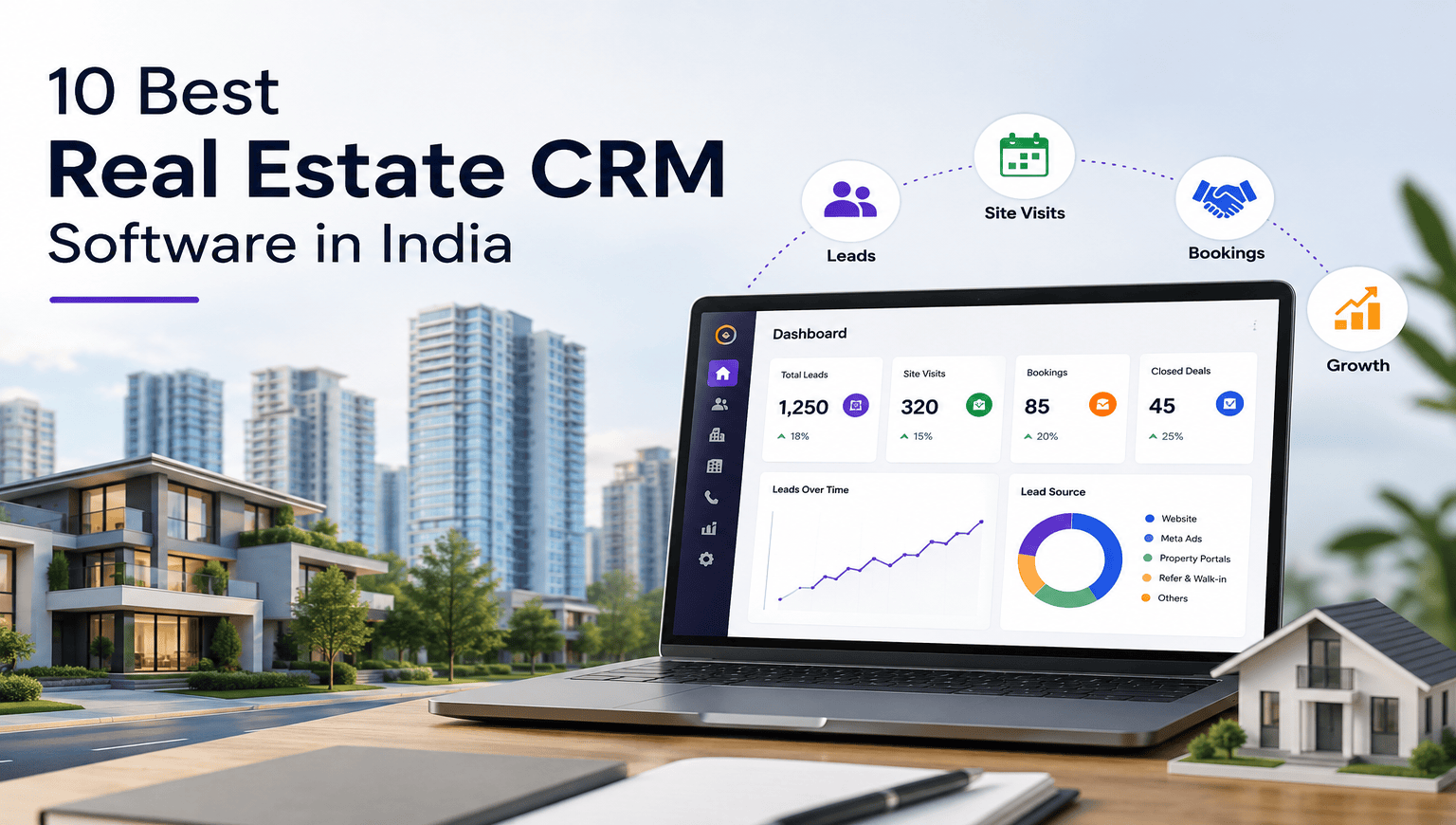
Real estate businesses deal with a lot of leads every day.
Some come from property portals. Others come through Google Ads, Meta Ads, websites, WhatsApp, phone calls and referrals.
The difficult part isn't always getting these leads. The real challenge is keeping track of them and following up at the right time.
This is where a real estate CRM can help.
Instead of keeping customer details in Excel, WhatsApp chats and different spreadsheets, a CRM gives your team one place to manage leads, conversations, follow-ups and sales.
If you're currently comparing options, this list can help you understand which CRM may suit your business.
Note: This isn't a strict ranking from #1 to #10. The right CRM depends on your team size, workflow and requirements.
Trevion CRM is built for businesses that want to manage real estate leads and sales activities in one place.
It offers lead management, follow-ups, site-visit management, project and property management, live location tracking, WhatsApp CRM, reporting and third-party integrations. Trevion also supports lead capture from Meta Ads and property portals such as MagicBricks, 99acres and Housing.com.
For builders and developers, CRM for Builders & Real Estate Developers can be useful when you need to manage projects, inventory, bookings, payments and channel partners along with leads.
Best for: Brokers, builders, developers and growing real estate sales teams.
Sell.Do is a real estate-focused platform with tools covering marketing, pre-sales, sales, inventory and post-sales.
It supports lead capture, lead routing, site-visit management, calling, sales automation and project-wise inventory management.
Best for: Large builders, developers and teams that need deeper sales and marketing automation.
LeadSquared offers a dedicated CRM for real estate brokers and businesses.
It focuses on capturing property enquiries, automatically distributing leads to salespeople, tracking customer interactions and managing real estate inventory.
Best for: Real estate companies that need strong lead automation and sales tracking.
Buildesk is designed specifically for the Indian real estate market and covers both CRM and broader real estate operations.
Its features include lead capture, automated follow-ups, site-visit tracking, reporting, inventory, bookings and channel-partner management. It also states that it can capture leads from 99acres, MagicBricks, Housing.com and Facebook Lead Ads. Best for: Builders, developers, brokers and businesses looking for CRM plus real estate operations.
Leadrat is another CRM built specifically for real estate teams, including agents, brokers and builders.
It focuses on centralized lead capture, automated follow-ups, lead routing, property management, team tracking and performance reporting. It also supports integrations with ads, portals and other lead sources. Best for: Brokers and real estate teams that want a mobile-friendly, real estate-specific CRM.
TeleCRM is focused strongly on lead management, sales communication and follow-ups.
Its real estate offering includes lead capture from portals, ads, websites and WhatsApp, along with calling, follow-up reminders, sales automation and reporting. Best for: Property dealers, brokers and sales teams that depend heavily on calls and WhatsApp communication.
Zoho CRM is a general CRM with dedicated solutions and features for real estate businesses.
It supports lead management, workflow automation, property management, mobile access and integrations. Zoho also highlights integrations with platforms such as MagicBricks and 99acres. Best for: Agencies and businesses that want a customizable CRM that can work across different business processes.
HubSpot is a popular general-purpose CRM that can also be used by real estate professionals.
It provides contact management, pipeline tracking, marketing automation, task management and reporting. HubSpot also offers a free CRM option for users who want to start with basic CRM functionality. Best for: Agents, agencies and growing businesses that want CRM plus broader marketing tools.
Salesforce is an enterprise-level CRM platform with solutions for real estate businesses.
It focuses on managing leads, contacts, workflows, sales processes and customer interactions across larger teams. Best for: Large real estate companies and enterprises that need extensive customization and scalability.
Odoo takes a broader approach by combining CRM with other business applications.
For real estate agencies, it supports property listings, customer relationship management, property visits and sales activities. Best for: Businesses that want CRM alongside other business management tools.
Don't choose a CRM simply because it has the longest feature list.
First, look at the problems your team faces every day.
Your CRM should make it easy to capture, assign and track enquiries from different sources. A dedicated [Real Estate Lead Management Software] solution can be particularly useful when your business receives a large number of enquiries from ads, portals and websites.
Missed follow-ups can mean missed sales. Look for reminders, tasks, call tracking and activity history.
Since WhatsApp is widely used for property communication, having **Real Estate CRM with WhatsApp Integration **can help keep customer conversations connected to the sales process instead of leaving important information inside individual chats.
Builders and developers have another requirement: knowing which units are available, held, booked or sold. A Real Estate CRM with Property & Inventory Tracking can bring this information closer to the sales process.
A CRM is useful only when your team actually uses it. Choose software that salespeople can understand without weeks of training.

The answer depends on your business.
For individual agents and small brokers: Look for simple lead management, calling, WhatsApp and follow-up features.
For property dealers and agencies: Focus on lead capture, communication, team management and sales reporting.
For builders and developers: Project management, inventory, site visits, channel partners, bookings and payment tracking become more important.
For large enterprises: Advanced automation, customization, integrations, analytics and scalability may matter more.
The goal isn't to find the CRM with the most features.
It's to find the one that fits your team's daily work.

A good real estate CRM should make your team's work easier, not more complicated.
Whether you're a broker managing a few properties or a developer handling multiple projects, the right CRM can help you organize leads, improve follow-ups and get better visibility into your sales pipeline.
Before choosing one, compare the features you actually need, test the software with your sales team and think about how it will support your business as you grow.
In the end, the best CRM isn't necessarily the biggest name in the market. It's the one your team can use consistently to manage leads and turn more enquiries into real business.
There is no single CRM that is best for every business. Trevion, Sell.Do, LeadSquared, Buildesk, Leadrat, TeleCRM, Zoho, HubSpot, Salesforce and Odoo all offer different approaches and are suited to different business needs.
A broker should look for easy lead management, follow-up reminders, calling, WhatsApp communication, property tracking and mobile access.
Builders often need more than basic lead management. Project management, inventory, site visits, bookings, payments and channel-partner management can be important requirements.
A CRM helps keep customer information, lead activity, follow-ups and sales data in one place, reducing the chances of missed enquiries and untracked customer interactions.

Tired of losing track of your leads? Automate follow-ups, capture inquiries instantly, and accelerate conversions with Trevion CRM.
Get the latest expert sales tips, workflows, and CRM insights to grow your business.