
Insights & Resources
Read Our Blogs
Helpful blogs, expert sales tips, and CRM guides written by industry specialists to help grow your business.
Helpful blogs, expert sales tips, and CRM guides written by industry specialists to help grow your business.
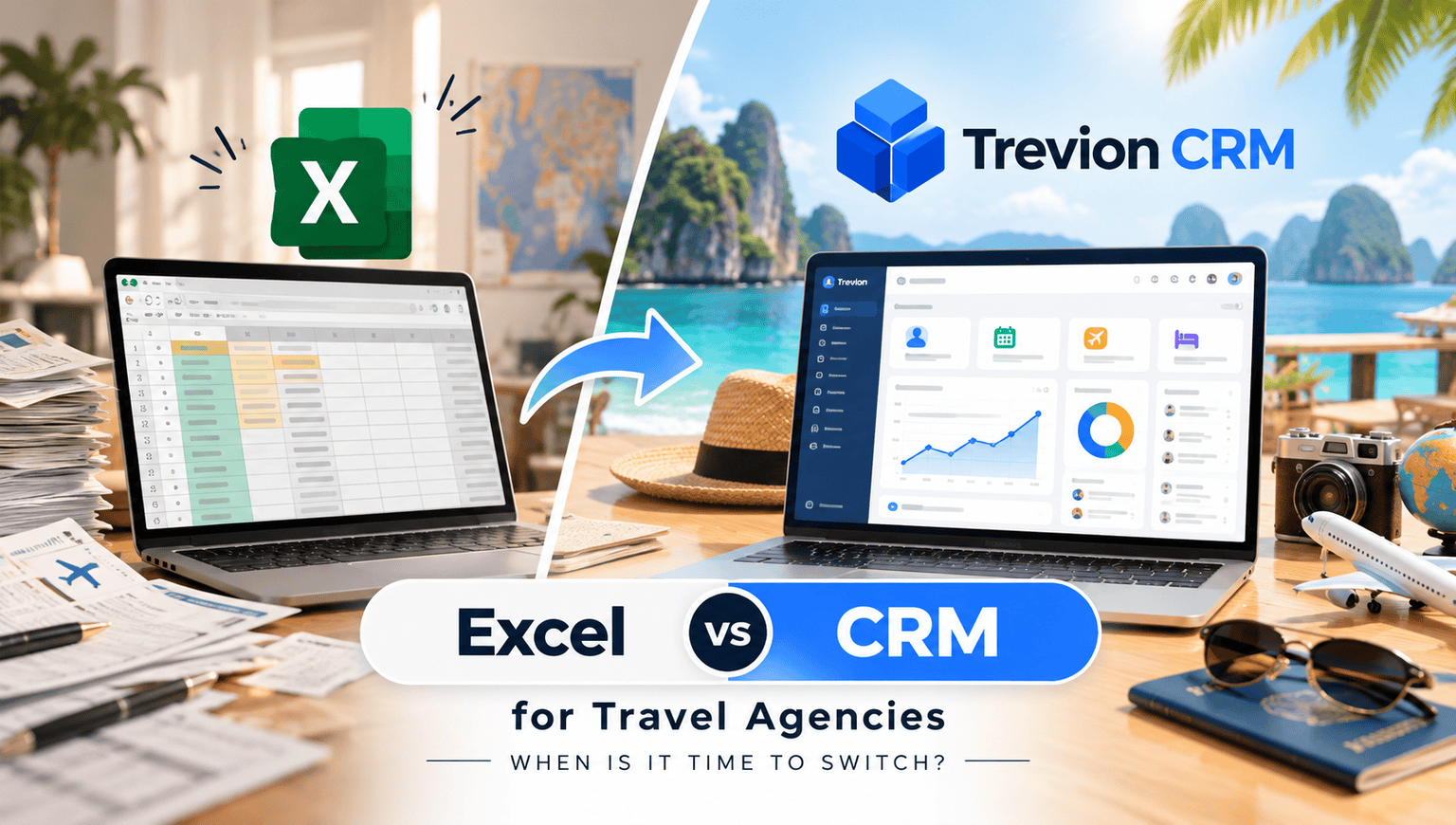
Almost every travel agency starts the same way. A spreadsheet, a phone full of chats, and a lot of hustle.
And honestly, that's a perfectly good start. Excel is free, familiar, and flexible. It gets the job done in the early days.
But here's the thing nobody tells you. Excel is a place to store information. It was never built to manage customers. And that's the core difference between Excel and a CRM. In travel, where every enquiry is a person making a big, emotional decision, that difference matters more than you'd think.
Most agencies don't switch because something breaks loudly. They switch because of small, quiet leaks that add up over time.
Follow-ups slip through. A sheet can hold a date, but it can't tap you on the shoulder and say, "this customer is waiting to hear from you."
When follow-ups depend on memory, even the most careful team misses some.
Enquiries arrive from everywhere. Calls, chats, social media messages, website forms. Not all of them make it into the sheet, and a lead you can't see is a lead you can't win.
Information gets scattered. Budgets, dates, preferences and past trips end up in different places. Customers get asked the same questions again, and that never feels like great service.
Nobody has the full picture. When more than one person handles customers, it becomes hard to know who spoke to whom, what was promised, and what comes next.
Customers disappear after the trip. Once a booking is done, the relationship often goes quiet, even though a happy traveller is your best source of repeat bookings and referrals.
None of these are signs of a bad agency. They're signs of a tool that has been stretched beyond what it was made for.
This is the biggest myth about CRMs: that they're meant for large teams with complicated setups.
The truth is, the problems above don't care about the size of your agency. A one-person business can lose a lead just as easily as a large team can. Whether you run a small agency, work as an independent travel consultant, or manage a tour operation, every single enquiry counts.
A travel CRM simply takes the repetitive, easy-to-forget parts of your day and handles them for you, so you can spend your energy on what you're actually good at: planning trips and talking to travellers.
Excel works fine when you're just starting out. Here's where the two really differ:
| Excel | CRM | |
|---|---|---|
| Follow-up reminders | You have to remember | Built-in reminders |
| Enquiries from different channels | Typed in by hand | Collected in one place |
| Customer history | Scattered across rows and chats | One profile per customer |
| Team visibility | Easy to overlap or miss | Everyone sees the same picture |
| After the trip | Easy to forget | Easy to stay in touch |
Think of it as an assistant that never gets tired or forgets.
There's no magic number of bookings. But if any of this sounds familiar, you're probably ready:
And if you're simply curious, that's reason enough too.
Switching doesn't have to be a big, scary project. Keep your old sheet for reference, and for the next couple of weeks, log only your new enquiries in a CRM. Many CRMs offer a free trial or a demo, so you can test one with real enquiries before committing to anything.
Then notice what changes. Are you replying faster? Missing fewer follow-ups? Spending less time hunting for details? If yes, you have your answer. If not, you've lost nothing.
Excel got you started. Your next chapter might just need a little more help.
In the early days, yes. Excel works well when you have only a few enquiries and one person handling them. It starts to struggle when enquiries come from many places, more than one person handles customers, or follow-ups depend on memory.
Excel stores information. A CRM helps you manage customers. It keeps every enquiry in one place, reminds you when to follow up, keeps one profile per customer, and gives your whole team the same view.
There's no magic number of bookings. It's usually time when you've lost track of an enquiry, you spend more time searching for details than selling, your team needs to work from the same page, or you want more repeat customers.
No. The problems of missed follow-ups and scattered details don't depend on the size of your agency. Independent consultants and small agencies can benefit just as much as larger teams.
Start small. Keep your old sheet for reference and log only new enquiries in the CRM. Many CRMs offer a free trial or a demo, so you can test one with real enquiries before committing.

Tired of losing track of your leads? Automate follow-ups, capture inquiries instantly, and accelerate conversions with Trevion CRM.
Get the latest expert sales tips, workflows, and CRM insights to grow your business.