
Insights & Resources
Read Our Blogs
Helpful blogs, expert sales tips, and CRM guides written by industry specialists to help grow your business.
Helpful blogs, expert sales tips, and CRM guides written by industry specialists to help grow your business.
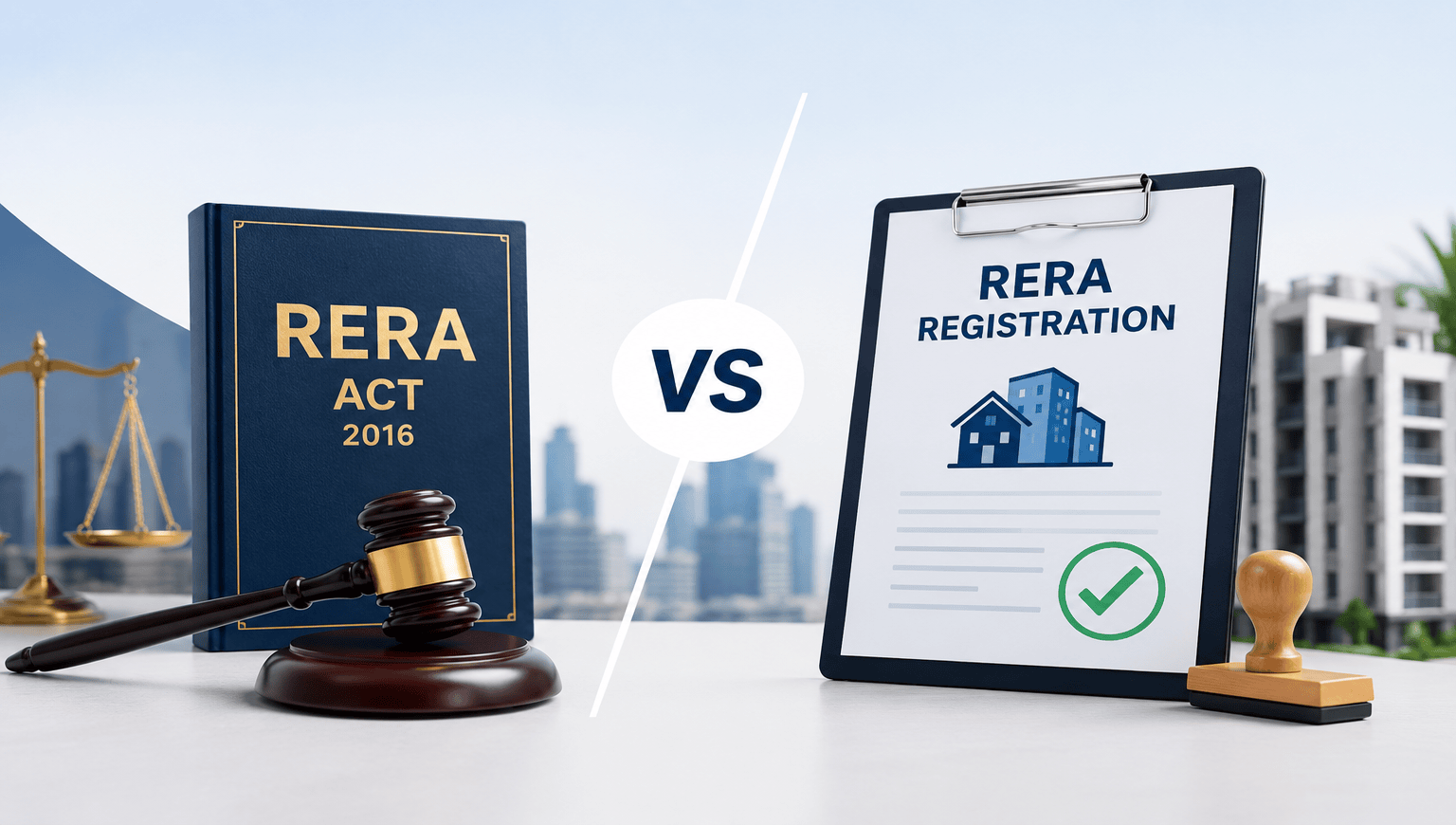
If you work in real estate, you have probably heard people say things like, “Is this project RERA registered?” or “Do you have a RERA registration?”
These questions sound similar, but they are not actually asking about the same thing.
This is where many agents, brokers and even new developers get confused.
RERA is the law that regulates the real estate sector in India. RERA registration, on the other hand, refers to the registration required under this law for certain real estate projects and agents.
So, what exactly is the difference?
Let's break it down in simple terms.
Important: RERA is implemented through state and Union Territory authorities, so the exact registration process, fees, documents and other requirements can differ from one state to another. This article is for general information and should not be treated as legal advice.
RERA stands for the Real Estate (Regulation and Development) Act, 2016.
The law was introduced to make the real estate sector more transparent and to protect the interests of homebuyers. It also lays down responsibilities for developers, promoters and real estate agents.
Before RERA, buyers often had difficulty getting clear information about projects, possession timelines and other important details.
RERA brought a more structured system for project registration, disclosures and accountability.
In simple words:
RERA is the law.
It sets the rules that developers, agents and other parties involved in real estate transactions need to follow.
This is where the confusion usually starts.
When someone says “RERA registration,” they could be talking about two different things:
These are separate registrations.
A developer may need to register a project with the relevant RERA authority.
At the same time, a real estate agent or broker dealing with projects covered by RERA may also need to obtain agent registration.
So, RERA registration doesn't always mean the same thing.
Think about it this way:
| RERA | RERA Registration |
|---|---|
| RERA is the real estate law | Registration is done under the RERA framework |
| It establishes rules for the sector | It provides registration for eligible projects or agents |
| Applies to developers, agents and other stakeholders | Can relate to a project or an agent |
| Creates compliance requirements | Gives a registration number/certificate where applicable |
The easiest way to remember it is:
RERA = The law
RERA Registration = Registration under that law

Let's say a builder is developing a residential project with multiple apartments.
Before marketing or selling the project, the developer needs to determine whether the project falls under the RERA registration requirements.
If registration is required, the project needs to be registered with the appropriate RERA authority.
Once registered, the project gets its own registration details.
This is what people usually mean when they ask:
“Is this project RERA registered?”
For developers, this is an important part of the project launch and sales process.
No.
There are certain exemptions under the RERA Act. For example, the central Act provides exemptions for certain smaller projects based on land area or the number of apartments, along with some other situations.
However, this is one area where developers should not make assumptions.
The applicable state or UT rules can affect how these provisions work.
So if you're a developer planning a new project, it's better to check the requirements applicable to that particular location instead of assuming that registration is or isn't required.
RERA doesn't only apply to builders.
It also has provisions for real estate agents.
Under Section 9 of the Act, agents facilitating the sale or purchase of plots, apartments or buildings in projects covered by the Act may need to obtain registration with the relevant RERA authority.
This is particularly important for brokers and agencies working with multiple developers.
For example, suppose a brokerage is selling apartments in several RERA-registered projects.
The brokerage should not only know the RERA status of those projects. It also needs to understand its own registration and compliance requirements as a real estate agent.

In situations covered by Section 9, yes.
A registered agent also has certain responsibilities under the Act.
For example, registered agents are expected to maintain prescribed records and documents, avoid unfair trade practices and not facilitate sales in projects that are required to be registered but aren't registered.
This means RERA compliance isn't just about getting a registration number and putting it on your website.
The way you handle property information, advertisements, customer communication and transactions also matters.
If you're managing a growing brokerage, having a proper system can make this easier. A Real Estate CRM can help keep leads, property details, customer conversations and follow-ups organized in one place.
Once a project or agent is registered, a registration number is issued by the relevant authority.
But remember that a project registration number and an agent registration number are not the same thing.
For example: ABC Developers → RERA registration for its project
XYZ Realty → RERA registration as a real estate agent
Both may have registration numbers, but they represent different registrations.
So whenever someone gives you a RERA number, it's worth checking what exactly that number belongs to.
For developers, RERA compliance starts before the project is marketed.
A developer needs to understand whether the project requires registration and what information needs to be submitted to the relevant authority.
But there is another important point.
RERA isn't something that ends once you receive the registration number.
Developers have ongoing responsibilities relating to project information, disclosures, timelines and communication with buyers.
This becomes even more important when a developer is handling several projects at the same time.
A good CRM for Builders & Real Estate Developers can help the sales and management team keep project information, leads, follow-ups and customer activities organized.
Of course, a CRM doesn't make a project legally compliant. It simply helps the team manage the information and day-to-day work more efficiently.
For brokers, one of the biggest challenges is managing information.
Imagine a brokerage working with:
Now add project details, site visits, documents and customer conversations to the mix.
It becomes very easy for information to get lost in spreadsheets or WhatsApp chats.
This is where a Real Estate Lead Management Software can be useful.
Instead of keeping everything in separate places, the team can maintain lead records, assign enquiries to salespeople, track follow-ups and keep the sales process visible to managers.
Being registered doesn't mean an agent can simply market any property in any way.
RERA lays down specific duties for registered agents.
Some important areas include:
Agents should be careful about facilitating transactions involving projects that are required to be registered but aren't.
Agents may need to maintain records and documents as required under the applicable rules.
Property advertisements and customer communication should not contain misleading claims.
Agents should provide buyers with relevant information and documents as required under the law.
Where applicable, the agent's RERA registration number needs to be quoted as required by the Act and applicable rules.
This is one reason developers should take RERA requirements seriously.
Under Section 59 of the RERA Act, a promoter who violates the project registration requirement can face a penalty that may extend to 10% of the estimated cost of the real estate project.
Further violations can result in additional penalties and, in certain circumstances, imprisonment.
The exact consequences depend on the nature of the violation and the orders of the relevant authority.
So, for developers, checking registration requirements before marketing or selling a project is much safer than trying to fix a compliance issue later.
The Act also provides penalties for agents who fail to comply with the registration requirements.
Under Section 62, an agent who fails to comply with Sections 9 and 10 can face a penalty of up to ₹10,000 for every day during which the violation continues, subject to the maximum specified under the Act.
This is why brokers shouldn't treat RERA registration as just another formality.
It is part of operating a real estate business within the regulatory framework.
Let's clear up one thing first:
A CRM does not make your business RERA compliant.
Legal compliance still depends on following the applicable law and rules.
However, a CRM can make it easier to manage the information involved in your sales process.
For example, a real estate agency can use a CRM to keep track of:
Store information about different developers and projects in one place.
Connect every enquiry with the property or project the customer is interested in.
Set reminders for calls, meetings and follow-ups so potential buyers don't get forgotten.
Track scheduled and completed site visits along with customer feedback.
Keep track of documents collected from customers and other important sales information.
Managers can see which salesperson is handling each lead and whether follow-ups are happening on time.
Businesses that receive leads from several sources can also benefit from Real Estate CRM with WhatsApp Integration, especially when a large part of customer communication happens through WhatsApp.
Here's the easiest way to understand the difference.
Imagine ABC Developers launches a residential project.
The developer checks the applicable RERA rules and registers the project with the relevant authority.
That registration belongs to the project.
Now imagine XYZ Realty, a brokerage, starts selling units in that project.
XYZ Realty has its own responsibilities as a real estate agent and may need its own agent registration under the applicable RERA framework.
So:
ABC Developers → Project registration
XYZ Realty → Agent registration
They are not the same registration.
If you're a developer, keep these points in mind:
For developers managing multiple projects, a structured CRM for Builders & Real Estate Developers can also help keep sales operations organized.
For brokers and agencies, the checklist is slightly different:
A CRM can help with the operational side of these activities, particularly when your team is handling a large number of leads.
If all of this still sounds confusing, remember these three points:
The Real Estate (Regulation and Development) Act, 2016 provides the regulatory framework for the real estate sector.
A developer may need to register a project, while a real estate agent may need to obtain agent registration.
Always check whether the number belongs to a project or an agent.
RERA has made transparency and accountability an important part of India's real estate industry.
But the terminology can be confusing, especially for people who are new to the industry.
The simplest way to understand it is:
RERA is the law. RERA registration is the registration process under that law.
Developers need to understand their project-registration requirements, while brokers and agents need to understand the rules applicable to their own registration and activities.
For real estate businesses, there is also the practical challenge of managing hundreds of leads, properties, site visits, documents and customer conversations.
That is where a good CRM can help.
Instead of managing everything through spreadsheets, WhatsApp chats and scattered notes, teams can use a centralized system to manage their day-to-day sales operations.
If you're evaluating a Best CRM for Real Estate Agents in India, look beyond the number of features. The right CRM should make it easier for your team to manage leads, follow-ups, properties and customers without creating more work.
And most importantly, remember that CRM software can support your business processes, but it does not replace RERA compliance or professional legal advice.
Always verify the latest requirements with the RERA authority applicable to your state or Union Territory before making compliance-related decisions.
RERA is the Real Estate (Regulation and Development) Act, 2016, which provides the regulatory framework for India's real estate sector. RERA registration refers to registering an eligible real estate project or agent under this framework.
Real estate agents who fall under the registration requirements of Section 9 of the RERA Act need to obtain registration with the relevant RERA authority before facilitating applicable property transactions.
No. The RERA Act provides certain exemptions, including some smaller projects and other specified situations. The applicable state or UT rules should be checked before deciding whether registration is required.
A RERA registration number is an identification number issued by the relevant RERA authority after registration. A project and a real estate agent can have separate registration numbers.

Tired of losing track of your leads? Automate follow-ups, capture inquiries instantly, and accelerate conversions with Trevion CRM.
Get the latest expert sales tips, workflows, and CRM insights to grow your business.