Insights & Resources
Read Our Blogs
Helpful blogs, expert sales tips, and CRM guides written by industry specialists to help grow your business.
Helpful blogs, expert sales tips, and CRM guides written by industry specialists to help grow your business.
You start a Meta Ads campaign.
The leads come in.
At first, everything looks good.
Then something changes.
You may still be getting plenty of leads, but your sales team starts saying:
“These leads aren't serious.”
Some people don't answer calls. Some aren't actually looking to buy. Others may have filled out the form just because they were curious.
So what happened?
The problem isn't always the ad itself. Sometimes Meta simply doesn't have enough information about which leads are actually valuable to your business.
This is where your CRM and Meta Conversions API can make a difference.
There are several reasons this can happen.
If your campaign is optimized simply to get more leads, the platform may focus on finding people who are likely to complete the form.
But completing a form doesn't necessarily mean someone is ready to buy a property.
For example:
1,000 Leads → 200 Contacted → 50 Qualified → 20 Site Visits → 5 Bookings
If you only send the first event—"Lead"—back to Meta, the platform has limited visibility into what happened afterward.
That's why looking only at CPL can be misleading.
A common mistake is to judge a campaign only by cost per lead (CPL).
Imagine two campaigns:
| Campaign | Leads | Cost/Lead | Qualified Leads |
|---|---|---|---|
| Campaign A | 500 | ₹100 | 20 |
| Campaign B | 300 | ₹150 | 60 |
Campaign A looks cheaper.
But Campaign B is producing three times as many qualified leads.
For a real estate business, the second campaign may be far more valuable.
Once a lead enters your CRM, your sales team starts adding useful information.
You can know whether the person:
This information is much more useful than simply knowing that someone submitted a form.
A Real Estate CRM can help your team track these activities from the first inquiry through the sales process.
This is where the two systems work together.
The basic flow is:
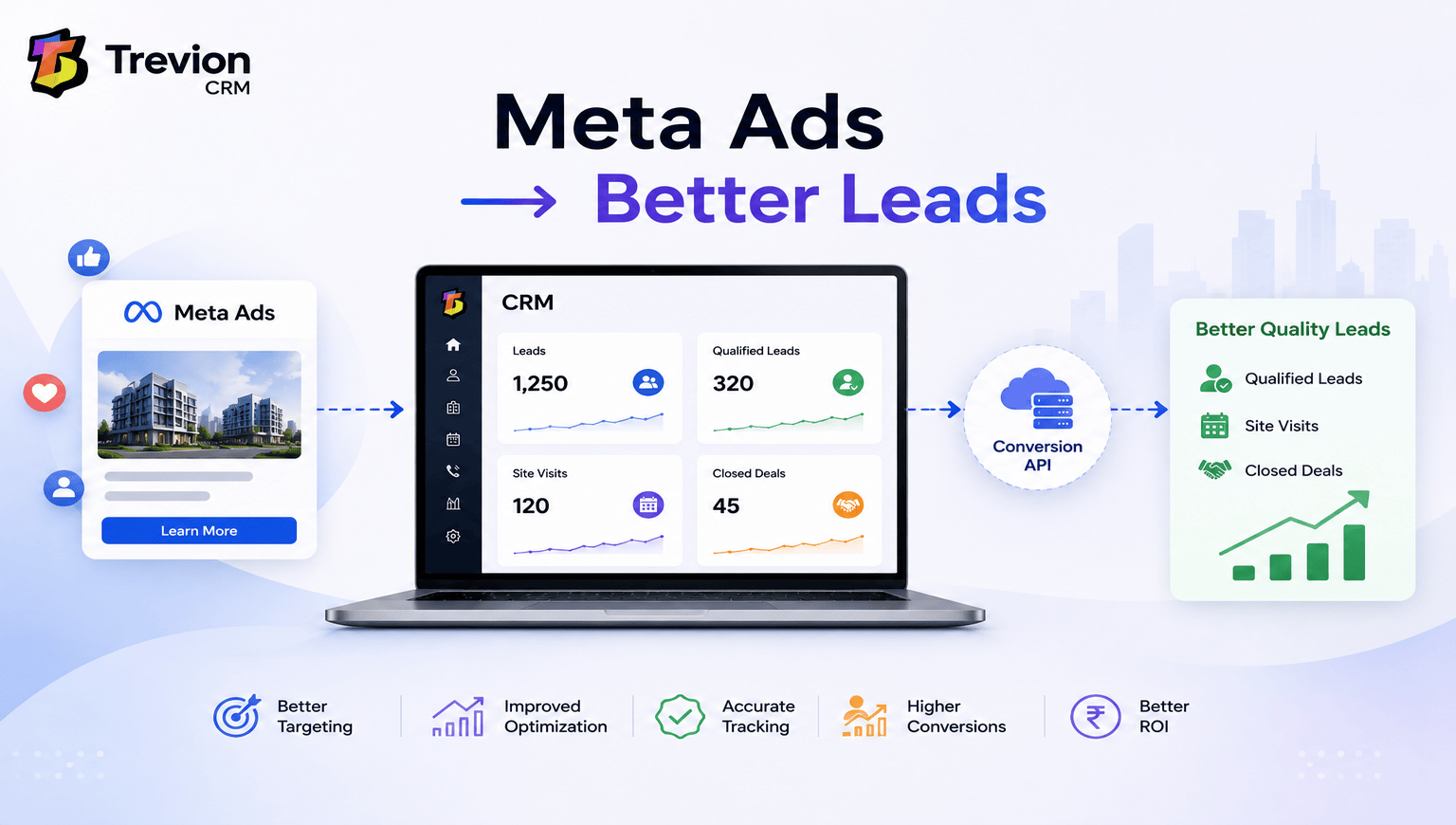
Meta Ad → Lead → CRM → Sales Activity → Qualified Lead → Site Visit → Booking
Your CRM records what happens to the lead.
The appropriate conversion information can then be sent back to Meta through Conversions API.
Meta describes CAPI as a direct connection between marketing data and its ad optimization systems, designed to help with optimization and outcome measurement.
This gives Meta a better signal about what happens after the initial lead.

Let's say you're advertising a new residential project.
A person sees your Meta Ad and submits a form.
The lead automatically enters your CRM.
Your salesperson calls and updates the lead.
The salesperson marks the lead as qualified based on your business criteria.
The customer visits the property.
The final conversion is recorded in the CRM.
Instead of treating every form submission as equally valuable, your business now has a clearer picture of which leads actually move through the funnel.
You don't necessarily need to send every CRM activity.
Start with the events that matter most to your business.
For a real estate company, these could include:
The exact event setup depends on your campaign and technical implementation.
The important thing is to connect meaningful business outcomes with your advertising data.
Suppose Meta generates 1,000 leads.
Without CRM feedback, you may see:
1,000 Leads → ₹X Cost Per Lead
But with better downstream tracking, you can start asking:
How many became qualified?
How many visited the property?
How many actually booked?
That gives your marketing team a much better way to judge campaign performance.
Meta has also been moving further toward qualified-lead optimization. As of April 2026, Meta says the qualified leads performance goal is no longer available for new campaign creation without Conversions API integration.

It's important to understand one thing:
CRM + CAPI won't magically turn bad leads into good leads.
If your targeting is wrong, your offer is unclear, or your sales team takes too long to respond, you can still get poor results.
The combination works best when all three parts are handled properly:
Good Advertising → Good Lead Management → Good Conversion Data
Your CRM manages the second part and can provide the business data needed for the third.
If you're running Meta Ads for real estate, your CRM should ideally help you track:
This helps marketing and sales teams work with the same information.
For builders managing multiple projects, a CRM for Builders and Real Estate Developers can bring lead management, project information, site visits, and sales activities into one system.
Before blaming Meta Ads, check these five things:
Are you reaching the right audience?
Does the advertisement clearly explain the property, price range, location, and offer?
Are you asking enough useful questions to filter casual inquiries?
How quickly is your team contacting new leads?
Are you telling your marketing system what happens after the lead is generated?
That last part is where CRM and CAPI become particularly useful.
Getting more leads isn't always the goal.
For real estate businesses, getting more qualified leads that actually move toward a site visit or booking is much more important.
Meta Ads can generate the initial interest, but your CRM captures what happens next. With a properly implemented Meta
Conversions API setup, meaningful conversion information can also be shared back with Meta to improve measurement and optimization.
So instead of asking only:
“How much did this lead cost?”
Start asking:
“What did this lead become?”
That shift—from lead volume to lead quality—can make your advertising decisions much smarter.
Low-quality leads can result from targeting, ad messaging, lead forms, campaign optimization, slow sales follow-ups, or limited conversion data being sent back to Meta.
A CRM itself doesn't improve lead quality automatically. However, it can track what happens after a lead is generated and provide better conversion data that can be used for marketing optimization.
Meta Conversions API is a server-side connection that allows businesses to send selected customer and conversion events directly to Meta.
Yes. It can be particularly useful for businesses with longer sales cycles, such as real estate, where a lead may go through calls, qualification, site visits, and booking before becoming a customer.

Tired of losing track of your leads? Automate follow-ups, capture inquiries instantly, and accelerate conversions with Trevion CRM.
Get the latest expert sales tips, workflows, and CRM insights to grow your business.