Insights & Resources
Read Our Blogs
Helpful blogs, expert sales tips, and CRM guides written by industry specialists to help grow your business.
Helpful blogs, expert sales tips, and CRM guides written by industry specialists to help grow your business.
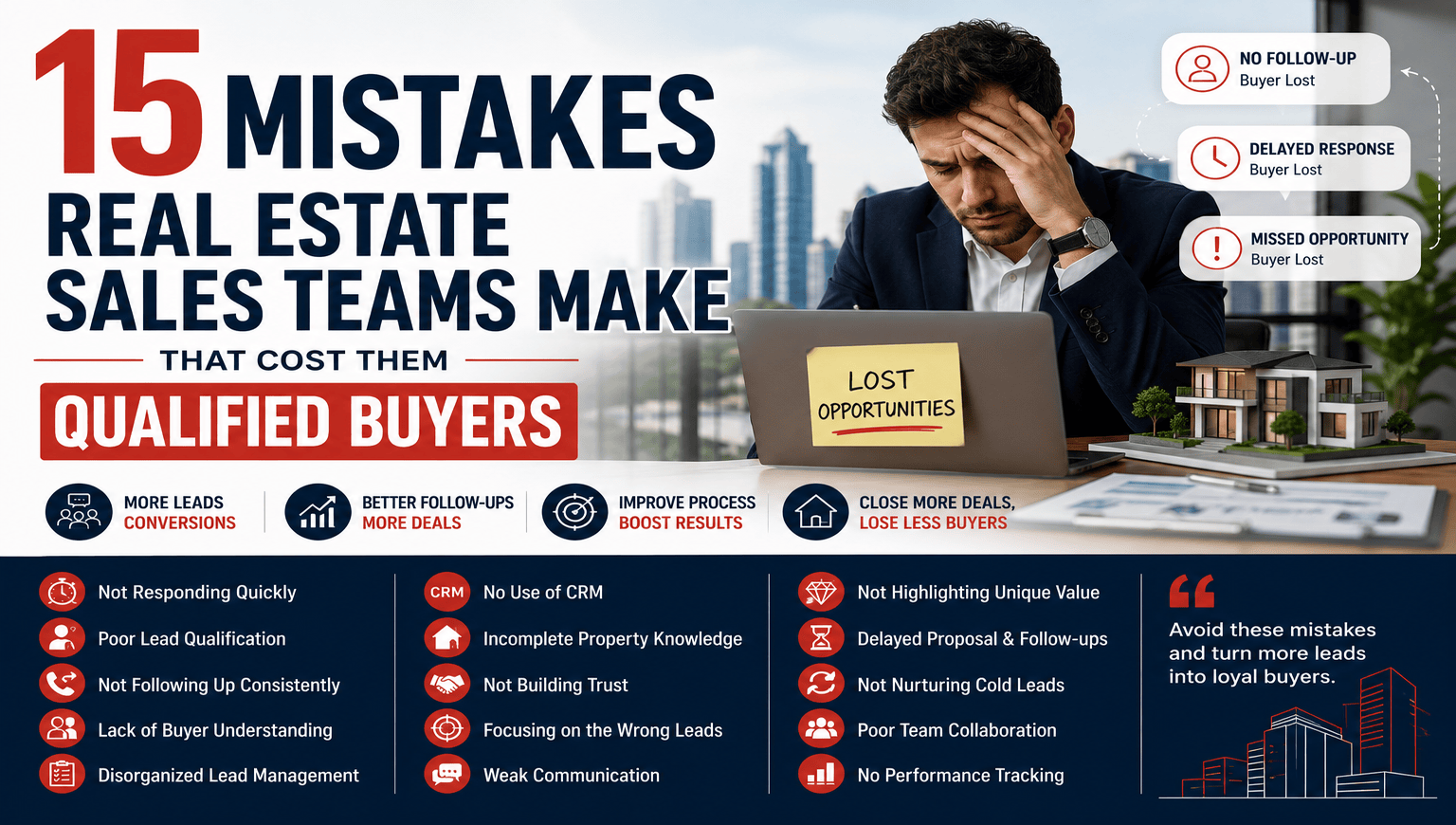
Most real estate companies think they're losing deals because of pricing, competition, or market conditions.
Sometimes that's true.
But after speaking with sales managers and looking at how enquiries move through a typical sales pipeline, a different picture usually appears.
The buyer was interested.
The project matched their budget.
The site visit happened.
And yet... the booking never came.
The surprising part?
Many of these buyers weren't lost because they said "no." They were lost because the sales process quietly broke down somewhere in between. Slow responses, forgotten follow-ups, inconsistent tracking, and unclear ownership are some of the biggest reasons qualified buyers slip away.
Let's look at the mistakes that quietly cost real estate businesses their best opportunities.
A buyer who fills out a form today is probably speaking to two or three other developers as well.
If your first response comes hours later—or worse, the next day—you've already given someone else a head start. Faster response times consistently improve the chances of qualifying a lead.
A family looking for a 3 BHK and an investor looking for rental returns shouldn't receive the same sales pitch.
Understanding why someone is buying changes the entire conversation.
"I'll call them tomorrow."
That's how many follow-ups get missed.
Good sales teams don't depend on memory. They depend on systems.
After a customer leaves, do you know:
If the answer is "not always," you're making future conversations harder than they need to be.
**
 **
**
Many buyers need several conversations before making a decision.
The mistake isn't following up.
It's giving up too early. Many teams stop well before the point where buyers are ready to decide.
When everyone thinks someone else is calling the customer...
Nobody does.
Every lead should have one clear owner.
A CRM isn't just a place to store names.
The best teams use it every day to schedule tasks, plan follow-ups, update lead stages, and monitor activity—not simply as a contact list.
Not every buyer is ready today.
That doesn't mean they're a bad lead.
Many deals happen weeks or even months after the first enquiry if communication stays consistent.
Your project isn't the only one they're visiting.
If you don't stay connected after the site visit, another developer probably will.
Nobody gets excited by:
"Just checking if you're interested."
Instead, send something useful.
A revised payment plan.
New inventory.
Construction updates.
Something that gives the buyer a reason to reply.
Managers shouldn't discover missed follow-ups at the end of the month.
They should be able to see pending activities every day.
When important customer details stay inside one salesperson's phone, the business becomes dependent on that individual.
Customer history should belong to the company—not to a single device.
Whenever bookings slow down, many businesses increase their ad budget.
Sometimes the better solution is improving what happens after the lead arrives.
Excel for leads.
WhatsApp for communication.
Google Calendar for appointments.
Sticky notes for reminders.
Eventually, information gets scattered and things start falling through the cracks.
Many developers solve this by adopting a CRM for Builders and Real Estate Developers, where leads, site visits, follow-ups, and customer history can be managed from one place.
Top-performing teams don't just review sales numbers.
They review why deals were won—and why they were lost.
That mindset helps them improve every month.
As enquiry volumes increase, many businesses also implement Real Estate Lead Management Software to ensure every opportunity is tracked from the first enquiry to the final booking.
Growing agencies often combine this with a CRM for Property Dealers to give sales teams one place to manage customer interactions, reminders, and deal progress.
Every real estate company loses some deals.
That's part of the business.
But losing buyers because of missed follow-ups, poor communication, or disorganized processes is completely avoidable.
The highest-performing sales teams don't always have the biggest marketing budget.
They simply have better systems.
And when better systems become part of everyday work, qualified buyers stop slipping through the cracks.

Tired of losing track of your leads? Automate follow-ups, capture inquiries instantly, and accelerate conversions with Trevion CRM.
Get the latest expert sales tips, workflows, and CRM insights to grow your business.