Insights & Resources
Read Our Blogs
Helpful blogs, expert sales tips, and CRM guides written by industry specialists to help grow your business.
Helpful blogs, expert sales tips, and CRM guides written by industry specialists to help grow your business.
If you're a property dealer, let me ask you a simple question.
How many leads did you receive last month?
Now another question.
How many of those leads did you actually follow up with 3 or 4 times?
For most property dealers, that's where the problem starts.
The issue isn't getting enquiries anymore. Facebook Ads, property portals, Google, referrals, and WhatsApp are already bringing leads. The real challenge is keeping track of them.
One customer asks for a 3 BHK in Noida.
Another wants a commercial property in Gurgaon.
Someone else books a site visit for Sunday.
Meanwhile, new enquiries keep coming in.
After a few days, things get messy.
You can't remember who was interested in which property, who asked for pricing, or who was supposed to visit the site next week.
This is exactly why more property dealers are moving away from spreadsheets and using CRM software.
Almost every property dealer starts with Excel.
And honestly, there's nothing wrong with that.
The problem starts when your business grows.
Once you're handling 50, 100, or even 500 enquiries every month, updating spreadsheets becomes a full-time job.
You spend more time searching for information than actually talking to customers.
Many real estate businesses eventually switch to systems that help them keep customer details, follow-ups, and site visits organized in one place.
A lot of CRM websites talk about features.
Let's talk about practical situations instead.
Imagine a lead comes from Facebook.

The customer doesn't answer today.
Without a system, you might forget to call again.
With a CRM, that follow-up stays visible until someone takes action.
Or suppose a customer visited a property two weeks ago and suddenly calls back asking about pricing.
Instead of searching through old chats and notes, you can instantly see the complete history.
That's where a CRM becomes useful.
Not because it has fancy dashboards.
Because it helps you stay organized.
Most real estate conversations today happen on WhatsApp.
Property photos, brochures, location pins, pricing details everything gets shared there.
The problem?
WhatsApp was built for communication, not lead management.
After a few weeks, important conversations get buried under hundreds of messages.
That's why many agencies are now looking for ways to connect WhatsApp conversations with their sales process.
The difference between busy teams and productive teams
Many property dealers think their team has a lead problem.
In reality, they often have a follow-up problem.
The highest-performing sales teams usually aren't the ones getting the most enquiries.
They're the ones following up consistently.
A CRM helps create that consistency.
Every call, site visit, reminder, and customer conversation becomes easier to track.
And when everyone on the team can see what's happening, fewer opportunities fall through the cracks.

There isn't one answer for everyone.
The right CRM depends on your team size, sales process, and lead volume.
But if you're evaluating options, focus on one thing:
Will this make life easier for my sales team?
Because at the end of the day, the best CRM isn't the one with the longest feature list.
It's the one your team actually uses.
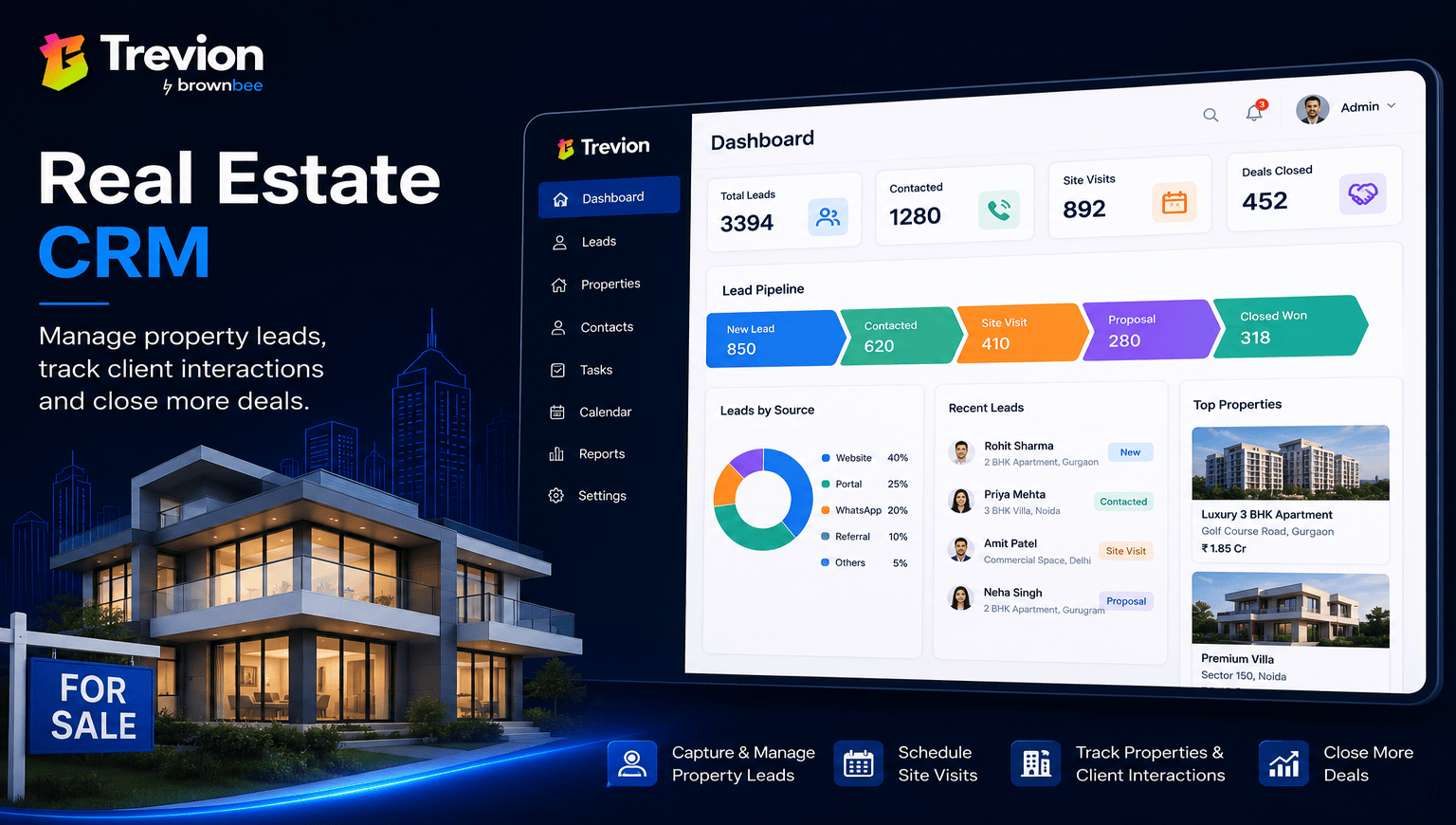
Platforms like Trevion CRM are becoming popular among real estate businesses because they focus on solving practical challenges such as lead tracking, followups, customer management, and sales visibility rather than adding unnecessary complexity.
Most property dealers don't lose deals because they don't work hard.
They lose deals because managing hundreds of conversations manually becomes impossible.
A CRM won't close deals for you.
But it can help ensure that no lead is forgotten, no follow-up is missed, and no opportunity slips away simply because things became difficult to track.
And in real estate, that can make a bigger difference than most people realize.

Tired of losing track of your leads? Automate follow-ups, capture inquiries instantly, and accelerate conversions with Trevion CRM.
Get the latest expert sales tips, workflows, and CRM insights to grow your business.